Mundinger Hug
Development of the Spray Technique
At the end of the 1960s, my father began to develop his own spray technique. He used cans of spray paint and cut out cardboard templates.
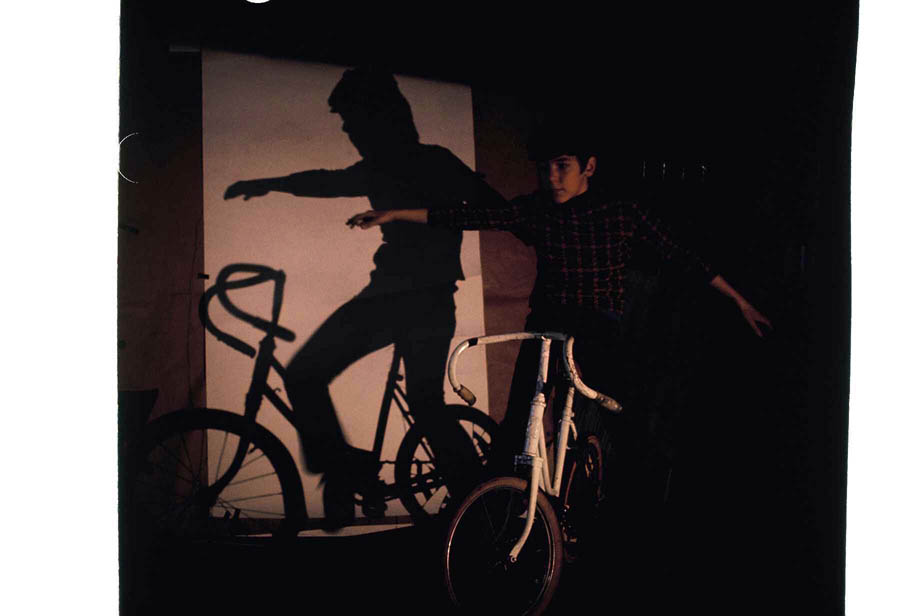
The first trials began in part with larger than life figures. The necessary templates were created through projection. By shining a light on a human model, their contour became visible on a piece of paper on the wall behind them. My father sketched these contours with a pencil and then cut out the model he had just created.
By changing the position of the light source, 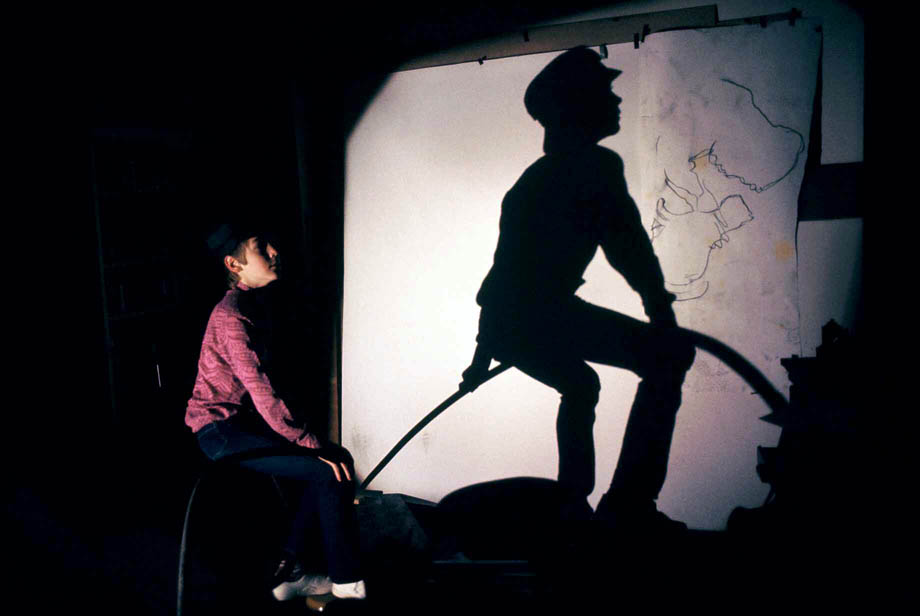
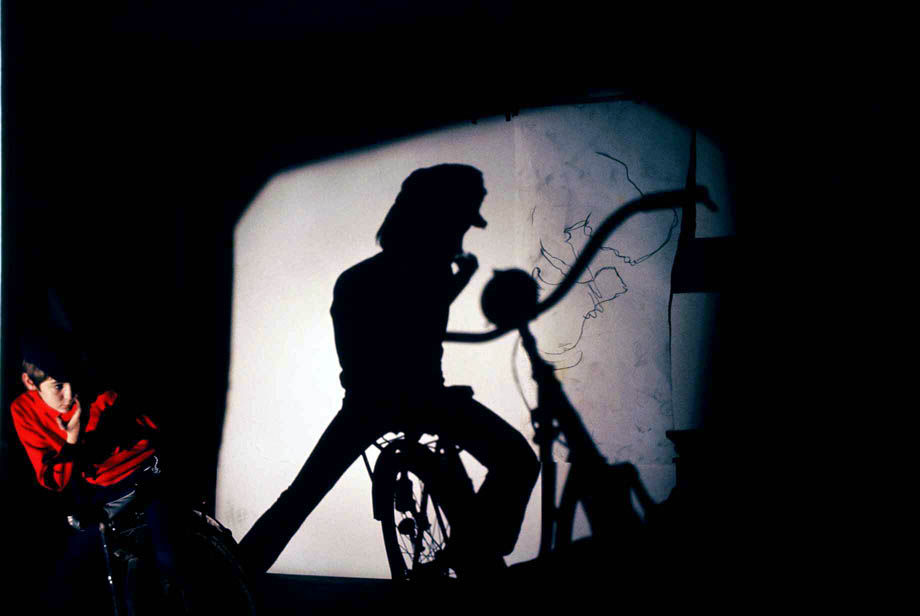 he could deliberately distort the projected figure.
These templates were
he could deliberately distort the projected figure.
These templates were
then placed on the painting surface (usually wood or cardboard) and sprayed using cans of spray paint. The resulting contours were then further processed. One common motif was a person with a bicycle. (I was the model for the paintings from the atelier.)
By photographing the model and then later projecting it, he could create smaller true to scale templates. 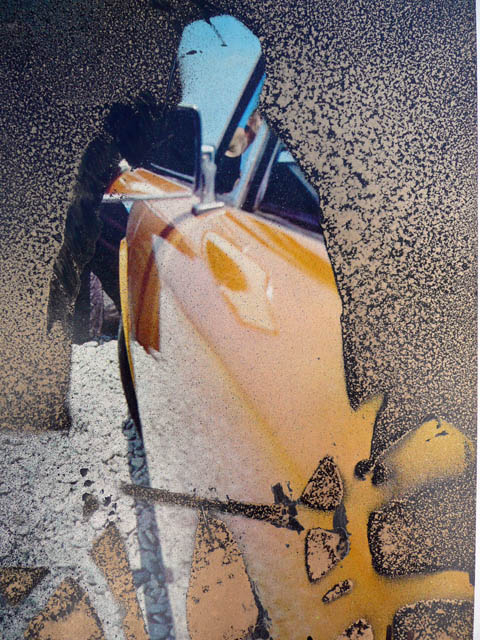
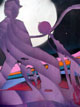 He also used these miniatures for a kind of collage technique for smaller format "bicyclist pictures", in which he also used cuttings from catalogs and newspapers.
In addition to his work with models, my father also began to use his spray technique for abstract designs. His first inspiration for this came from sunlight. Light and shadow from partially closed Venetian blinds fell on his worktable. My father laid straight templates on the pattern presented to him according to the light and dark areas. By then spraying the templates with spray paint, he created a geometric depiction of the sunlight's play of light and shadow. These were then further processed. 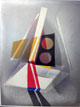
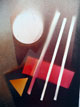
Later, my father began to add circular forms. He was particularly interested in the tension between straight lines and circles.
He was also excited about the possibility of spatial design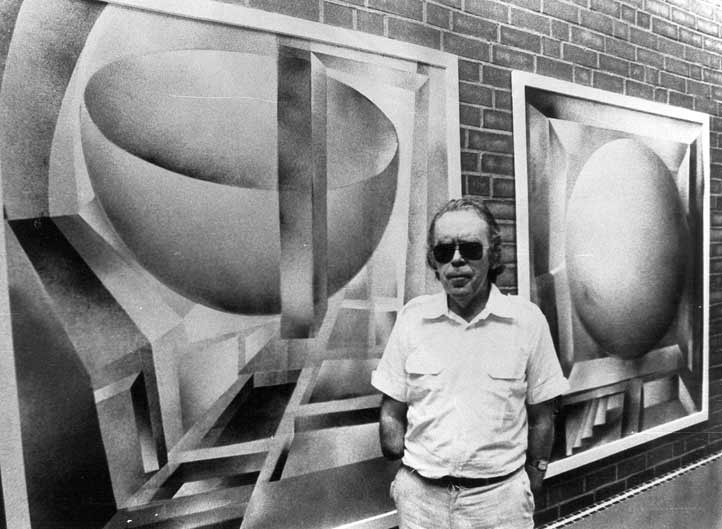 . The sphere became one of his central themes.
 Paintings which had hitherto been
created only using spray paints were now made more three-dimensional through the addition of sand/gravel and spackling compound.
SHis interests in physics and particularly in space exploration lead him to paint more open forms, culminating in his depiction of a supernova. 

Through these paintings and his interest in outer space, he came into contact with various physicists including Prof. Michael Soffel (University of Dresden).
The paintings became even larger and appear to be indefinitely expandable. (endless painting) Just as there is no up or down in outer space , no top or bottom or any kind of boundaries can be seen in his large multipart paintings (due to his missing hands and thus limited range, my father could only work on paintings up to a certain size).
Tübingen, summer 2008, Stefan Mundinger